Freda Cepparrone is an Italian contemporary Artist and Photographer, born in December 1989 in Bergamo, Italy.
Her relationship with images began at an early age, when she started taking photographs with her father’s analogue camera, gradually developing a personal and intimate visual language. Photography became her first means of expression and the beginning of a broader artistic practice that today moves between photography, paper sculpture and oil painting.
At the heart of Freda’s sculptural work is paper, a material she explores for its apparent fragility and its unexpected ability to become structure. Through folding, repetition and precise manipulation, flat surfaces are transformed into three-dimensional forms in which geometry, architecture, rhythm, light and shadow become integral parts of the work.
Material itself plays an essential role in her practice. Freda works with carefully selected and unusual papers, including extremely rare antique Korean wallpaper papers, no longer obtainable and preserved in very limited quantities. Their age, texture, imperfections and history become part of the artwork, giving each piece a unique material identity and making certain works intrinsically unrepeatable.
Alongside her sculptural work with paper, Freda paints in oil, focusing primarily on the human figure and, in particular, on faces. The human face has always been one of the central subjects of her research: both in photography and painting, she is drawn to the idea that every face carries a story, and that every line, mark and imperfection on the skin can become a trace of lived experience. Expressions, features, shadows and light become a way of exploring individuality, presence and the complexity of human identity.
Her different practices are not conceived as separate territories, but often intersect within the same work: in fact, paper modules and sculptural elements frequently become part of her oil paintings, extending beyond the painted surface and creating a dialogue between image and object, two-dimensional representation and physical form. Photography is also an integral part of this process, as the subjects of her paintings often originate from photographs she has taken herself.
This fascination with people creates a continuous dialogue between her photographic and pictorial practice. While photography allows her to capture fleeting expressions and moments, painting gives her the possibility to slow the image down, interpret it and reconstruct the presence of a person through colour, texture and gesture.
Her work is driven by an ongoing curiosity for materials, people, art, design and architecture. Photography, painting and sculpture become different ways of investigating the same questions: how an image becomes presence, how a surface becomes form, and how a material can carry memory.
Freda is currently based in Italy, while working internationally. She travels frequently to exhibit her work and to encounter new places, cultures and visual languages that continually offer new perspectives and sources of inspiration for her artistic research.
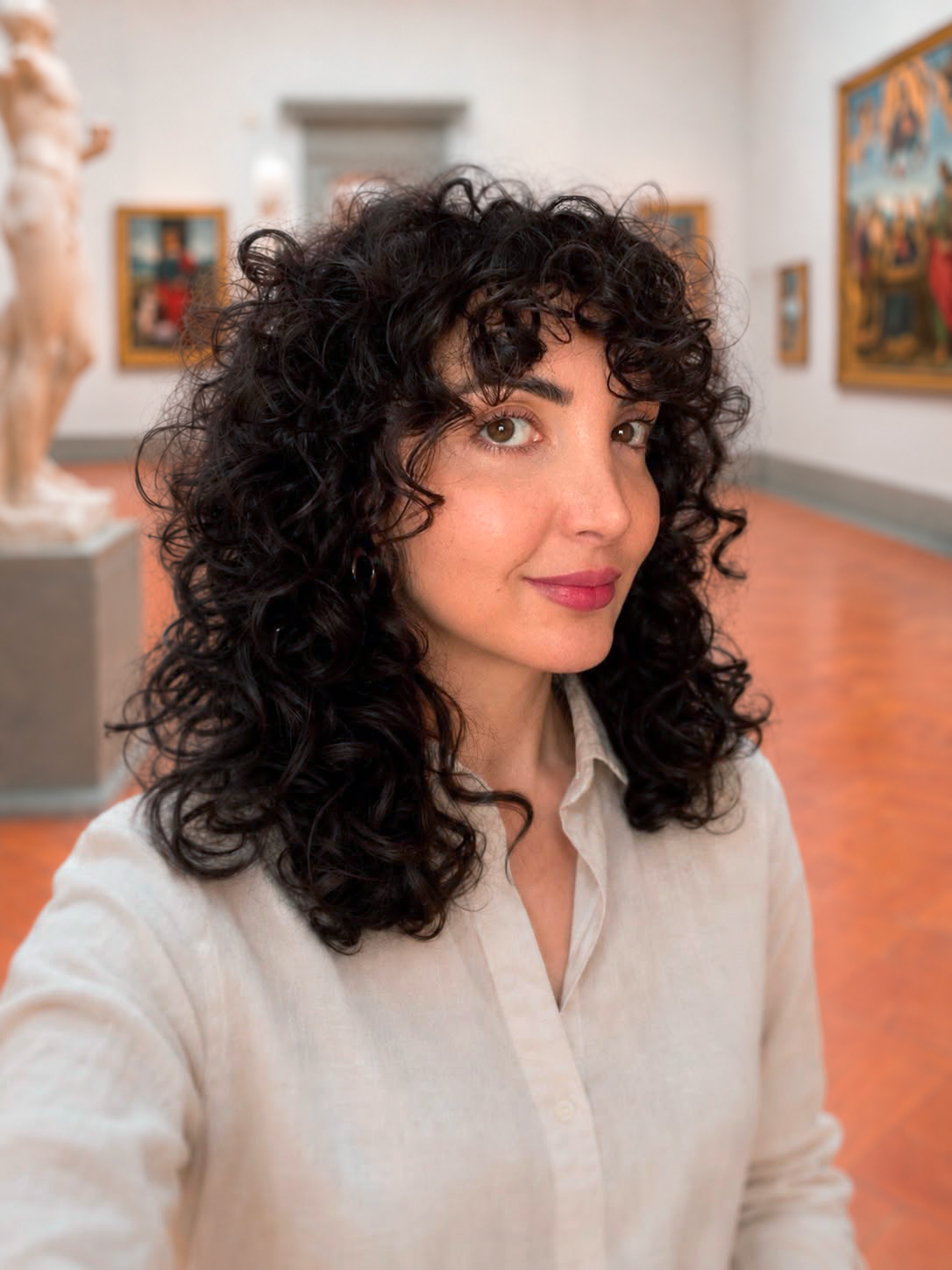
Freda Cepparrone is an Italian contemporary Artist and Photographer, born in December 1989 in Bergamo, Italy.
Her relationship with images began at an early age, when she started taking photographs with her father’s analogue camera, gradually developing a personal and intimate visual language. Photography became her first means of expression and the beginning of a broader artistic practice that today moves between photography, paper sculpture and oil painting.
At the heart of Freda’s sculptural work is paper, a material she explores for its apparent fragility and its unexpected ability to become structure. Through folding, repetition and precise manipulation, flat surfaces are transformed into three-dimensional forms in which geometry, architecture, rhythm, light and shadow become integral parts of the work.
Material itself plays an essential role in her practice. Freda works with carefully selected and unusual papers, including extremely rare antique Korean wallpaper papers, no longer obtainable and preserved in very limited quantities. Their age, texture, imperfections and history become part of the artwork, giving each piece a unique material identity and making certain works intrinsically unrepeatable.
Alongside her sculptural work with paper, Freda paints in oil, focusing primarily on the human figure and, in particular, on faces. The human face has always been one of the central subjects of her research: both in photography and painting, she is drawn to the idea that every face carries a story, and that every line, mark and imperfection on the skin can become a trace of lived experience. Expressions, features, shadows and light become a way of exploring individuality, presence and the complexity of human identity.
Her different practices are not conceived as separate territories, but often intersect within the same work: in fact, paper modules and sculptural elements frequently become part of her oil paintings, extending beyond the painted surface and creating a dialogue between image and object, two-dimensional representation and physical form. Photography is also an integral part of this process, as the subjects of her paintings often originate from photographs she has taken herself.
This fascination with people creates a continuous dialogue between her photographic and pictorial practice. While photography allows her to capture fleeting expressions and moments, painting gives her the possibility to slow the image down, interpret it and reconstruct the presence of a person through colour, texture and gesture.
Her work is driven by an ongoing curiosity for materials, people, art, design and architecture. Photography, painting and sculpture become different ways of investigating the same questions: how an image becomes presence, how a surface becomes form, and how a material can carry memory.
Freda is currently based in Italy, while working internationally. She travels frequently to exhibit her work and to encounter new places, cultures and visual languages that continually offer new perspectives and sources of inspiration for her artistic research.